Back to portfolio
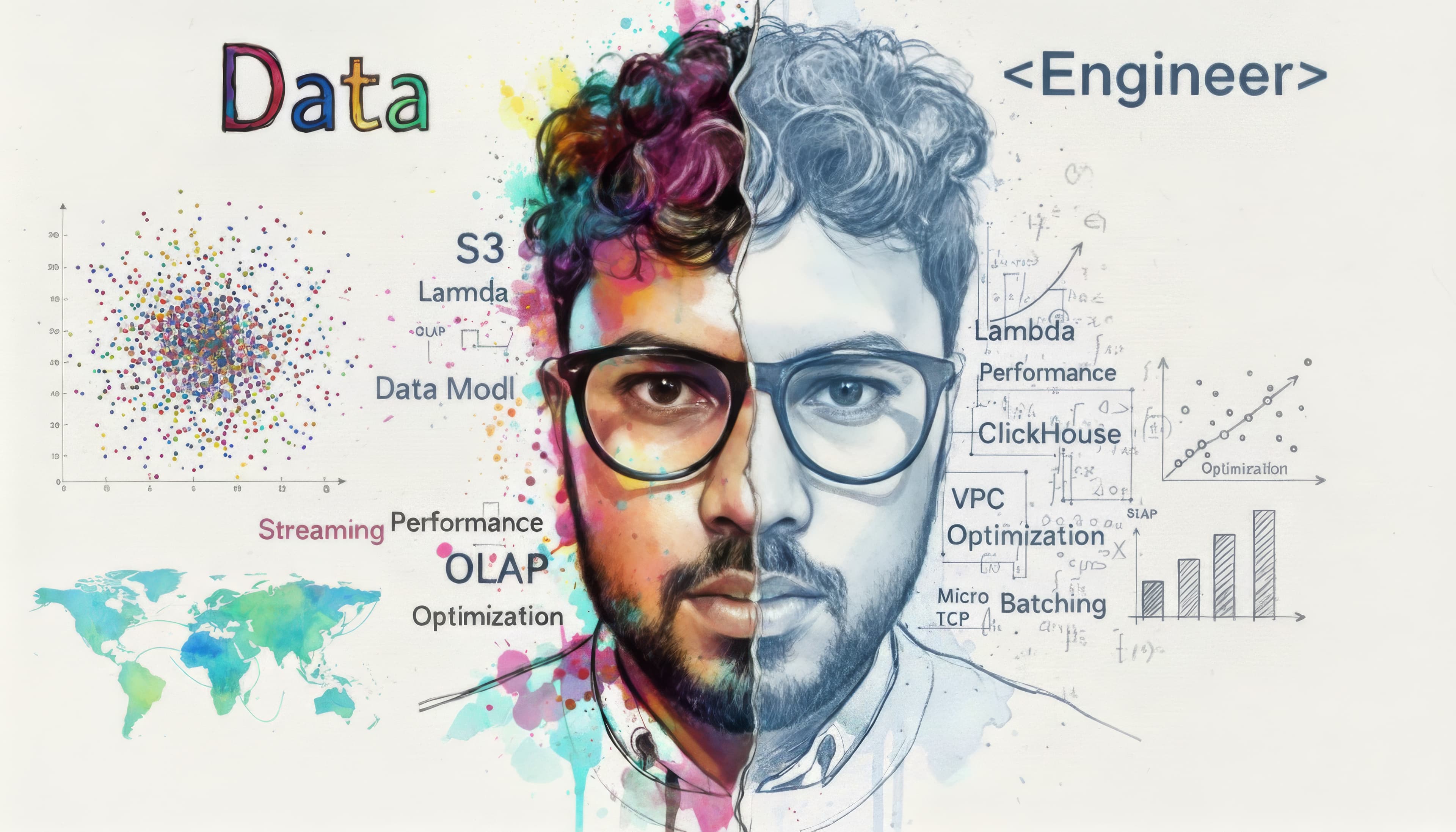
An illustrated portrait of Vikramaditya surrounded by data engineering sketches

About me

The thinking behind the work

My story

My career began on the DynamoDB metadata team at AWS, where I spent my internship writing client discovery services.

A foundation in systems

Few engineers work alongside people who build infrastructure at that scale so early in their careers, and that team had a lasting influence on me. I watched experienced engineers evaluate every decision about networking, concurrency and memory by its effect on latency and cost for the services that depended on it. I adopted that discipline, and it still shapes how I approach a problem. Before I commit to a design, I want to understand where the latency comes from, what each request costs and which tradeoffs I am accepting.

Owning what I build

At SecurityHQ I applied that discipline to security analytics and took full ownership of the infrastructure behind it. I built and operated a MongoDB cluster on EC2 with sharding, replication, S3 backups and Ops Manager, and designed the time series collections, aggregation pipelines and ETL that ran on it. Owning the platform alongside the data changed my definition of finished. A successful pipeline run was the minimum. I was the one operating the system long term, so I designed for its failure modes and recovery from the start, and structured it so that others on the team could understand and work with it too.

As the platform grew to include ClickHouse and more complex Airflow orchestration, I held it to the standards of any production software. My DAGs are built around single responsibilities, reusable components and explicit failure handling, so another engineer can change them with confidence. I design data models around the queries they serve, since the model determines both response time and compute cost. In ClickHouse that means treating sort keys, partitioning and table engines as architectural decisions with measurable consequences for performance and spend.

Making the reasoning clear

Leading a team extended my responsibility from the systems to the decisions around them. I work with stakeholders to define requirements, align priorities and make tradeoffs explicit before they become surprises. When delivery is under pressure, I make expectations more precise. I set out what we know, what remains uncertain and what we can commit to. Stakeholders who understand the reasoning behind a plan can adapt when circumstances change. I give my engineers the same context, so they can make sound decisions independently.

From infrastructure to product

I have realised that in 2026 you can’t get far without talking about AI, so here goes. I build full stack applications with AI agents. I direct them with established design patterns and clear architectural boundaries, and I review their output with the same rigour I apply to any code review. They have shortened the time between an idea and a working prototype. Accountability for what ships remains mine.

Cost awareness also guides my choice of analytical tools. Many workloads do not justify a distributed cluster. DuckDB, Polars and Apache Arrow handle substantial analysis on a single node, with zero copy interchange through Arrow. WebAssembly is where this gets genuinely fun for me, because it lets me move compute to the client. The warehouse does the heavy lifting once and produces the latest materialised rollup, which can still run to millions of rows. That result set ships to the browser as Arrow or Parquet, and from there every filter, drill down and regrouping runs locally in DuckDB Wasm. The user gets a responsive, interactive experience, and the OLAP warehouse is spared a steady stream of exploratory queries that would otherwise cost compute and compete for concurrency. My focus is the full path from the underlying data to a result someone can act on, and getting the split between server and client right is one of my favourite parts of that path.

Across these roles my approach has stayed consistent. Creativity helps me find a viable path through a problem, and systems thinking tells me what that path costs everything around it. AWS taught me to measure the cost of a decision. Owning infrastructure taught me to design for failure. Leading a team taught me that a technical decision depends on the shared understanding behind it. I bring all three to every pipeline I design and every result I present.

Testimonials

I offer my sincere recommendation for Vikramaditya. He has an impressive set of skills, particularly in Python, MongoDB, and RDBMS. Vikramaditya is a skilled developer who has deep knowledge of Python for data processing and automation. Additionally, he has a great reputation for his ability to manage and administer MongoDB databases, ensuring optimal performance and data integrity. In addition to his technical expertise, Vikramaditya has excellent problem-solving skills and is a great collaborator and communicator.
Derek HoogewerfInformation Security | Cloud Security | AWS Certified Solutions ArchitectRead on LinkedIn

My experience

  1. to present

    Lead Data Engineer

    SecurityHQ

    London, United Kingdom

    • I led the migration from a sharded MongoDB cluster to ClickHouse Cloud, improving analytical query performance by over 1,000x and reducing annual platform costs by 75%.
    • I designed a reusable Airflow ingestion framework and utility library. New pipelines reach production in 2 to 4 weeks, down from over a month.
    • I mentor five data engineers through code reviews, Airflow DAG design, and database schema decisions.
    • I built a production AWS Bedrock workflow with SOC analysts, using structured outputs and Airflow orchestration to reduce manual triage time by 40%.
    • I established CI/CD for Airflow DAGs, Docker images, and Devcontainers with GitHub Actions, and use pytest for pipeline testing.
    • I built semantic reconciliation with FAISS and Polars to map unstructured inputs to schemas and remove manual work.
    • I partner with product managers and security analysts on delivery roadmaps, using proofs of concept to guide platform decisions.
    • ClickHouse Cloud
    • Apache Airflow
    • AWS Bedrock
    • Python
    • Docker
    • GitHub Actions
  2. to

    Data Engineer

    SecurityHQ

    London, United Kingdom

    • I built asynchronous Python pipelines processing over 10 TB of security event logs each week, with Airflow ingesting data from APIs and S3.
    • I added data lineage and handled API rate limits and worker memory pressure to sustain pipeline success above 95%.
    • I designed and deployed a secure, self-hosted sharded MongoDB cluster in three months and served as the team's MongoDB subject matter expert.
    • I built Tableau integrity dashboards that reconciled REST API metadata with target tables to monitor data reliability.
    • MongoDB
    • Python
    • Apache Airflow
    • AWS S3
    • Tableau
  3. to

    Associate Software Support Engineer

    AMCS Group

    Limerick, Ireland

    • I optimised SQL Server databases for enterprise customers, improving query performance and data integrity.
    • I investigated database errors, performance bottlenecks, and compatibility issues, using CPU, memory, and disk monitoring to trace the cause.
    • SQL Server
  4. to

    Software Development Engineer 1 Intern

    Amazon Web Services (AWS)

    Dublin, Ireland

    • I built a metadata component for the DynamoDB team's client discovery service.
    • I migrated client discovery from Java to Rust, removing garbage collection pauses and achieving consistent client-side latency below 1 ms.
    • I optimised the service with multithreading, an asynchronous networking runtime, and wire-level data compression.
    • Amazon DynamoDB
    • Rust
    • Java

My education

  • Post Graduate Diploma in Data Analytics

    National College of Ireland

    Dublin, Ireland
  • Bachelor of Computer Applications

    Pune University

    MITSOM College, now MIT WPU

    Pune, India

My interests